So, 1.8 BILLION people at risk of of waterborne diseases, because of a lack of wastewater treatment. The graph below shows the percentage of wastewater treated before released back into the environment for all countries, and how much plastic marine debris is mismanaged. The major issue here is that legislation for wastewater treatment and release is not consistent worldwide, and there are no global regulations for wastewater treatment, leading to a massive gap in wastewater treatment quality between developed and developing countries.
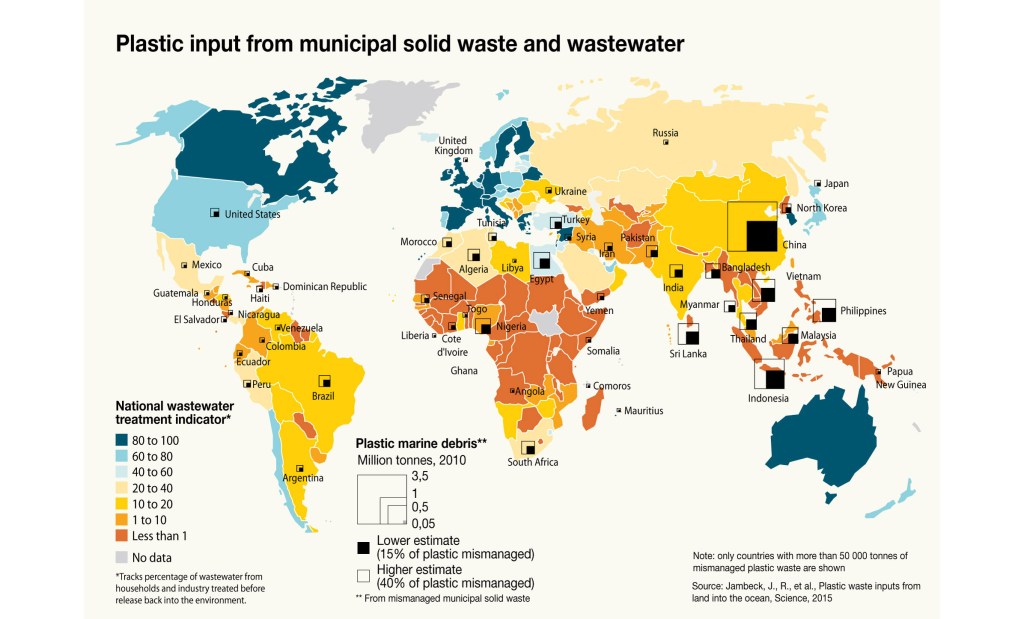
And you might think, why should I care? And I had the same thought, as I live in a developed country where our wastewater is treated to a very high standard before being released back into the environment. The ocean is actually not as big as we think, despite the fact that 70% of the earth’s surface is covered by water because what goes around comes around. We need to maintain our ecosystems, particularly for marine life and other organisms that choose to make the water their home, to keep everything in balance, in line with the UN’s Sustainable Development Goals (SDGs), particularly number 14 (life below water) in this case. We need to sustainably manage and protect ecosystems from pollution, even a small amount of pollution can affect the entire ecosystem. Marine ecosystems affect public health, as many of us choose to make fish and seafood part of our diet, important to SDG 3 which is to maintain good health and wellbeing worldwide. Recreational water activities are also a reason to keep our water clean as we want to maintain cleanliness for activities like fishing, swimming and finally, of course, maintaining aesthetics (look at those pristine WA beaches). So overall, we’d like to maintain clean water and sanitation by high quality standards for wastewater treatment to ensure we all have access to clean water and sanitation, which is SDG 6, as this affects both life below water and overall health and well-being.
So, let’s take a brief look at a few case studies regarding wastewater legislation worldwide, and click the link if you want to read a few more.
In Australia, each state and territory has the responsibility to regulate and manage natural resources and public health. The 2004 National Water Initiative was signed by all of Australia’s state and territorial governments to ensure a consistent approach across the country to water and wastewater planning. So generally, the water is treated to a fairly high quality. Within WA, Water Corporation manages all ocean outfall activity in line with Perth’s Coastal Waters Environmental Management Framework. The conditions specify the quantity and quality of treated wastewater to be released back into the ocean, so generally, the water and treated wastewater quality is quite high in Australia.
In Finland, there are a number of wastewater plants which use the energy content in the sludge produced from wastewater in order to produce biogas. In particular, the Viikinmäki wastewater treatment plant serves about 800000 people and uses biogas (a renewable energy) to run the system, which is totally self-sufficient in heating and about 50% self-sufficient in electricity, contributing to SDG 11, working towards sustainable cities and communities. There is also a transboundary co-operation on water with Sweden, Norway and Russia to ensure consistency in protecting management of waters. Finland believes that ‘Nature and its biodiversity, the environment and the national heritage are the responsibility of everyone. The public authorities shall endeavour to guarantee for everyone the right to a health environment and for everyone the possibility to influence the decision that concern their own living environment’, and I agree that placing responsibility on each individual is a good way to maintain high water and wastewater treatment quality. Overall, there is a comprehensive and participatory approach to wastewater management at both the national level and regional level (as Finland is a member of the EU), with effective legislation and agreements governing the Baltic sea. There is also a high level of technological development and investment in the wastewater sector.
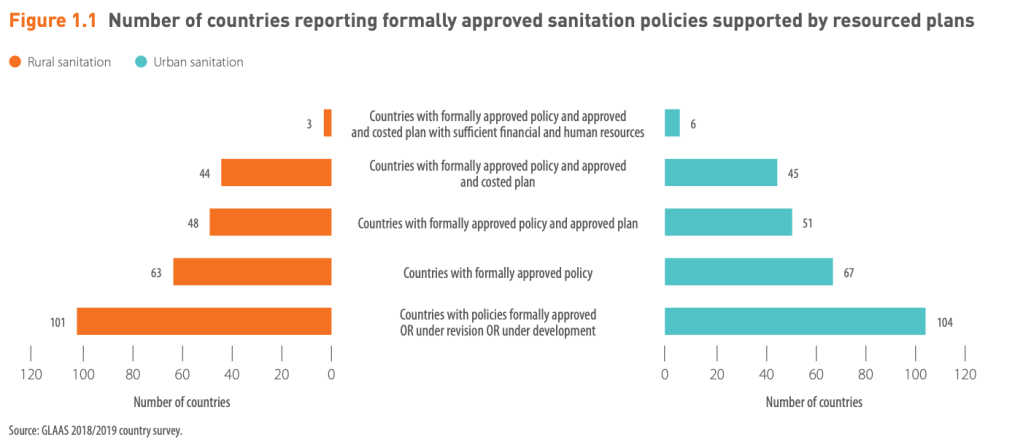
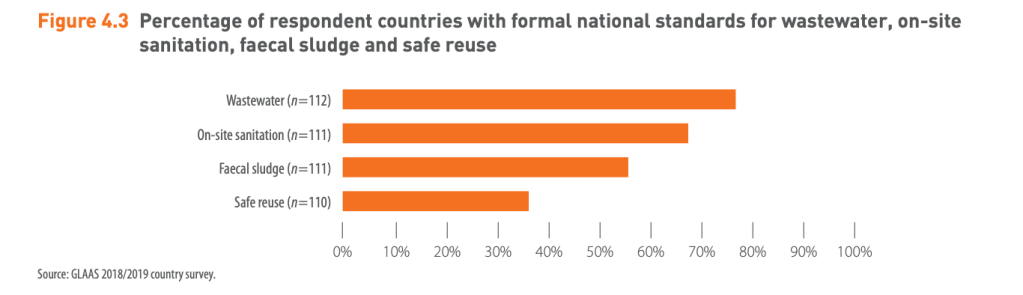
However, investment in the wastewater sector is not necessarily so accessible for all countries. In fact, as we can see from the diagram below, many countries have a sanitation plan (as wastewater treatment and sanitation pretty much go hand-in-hand), but not necessarily the funding to prove it. We can see from below that the number of countries that have sanitation and/or wastewater policies is quite high, however, few countries have the financial resources to implement these policies. So despite 80% of countries having formal national standards for wastewater, they may not be in use due to the lack of financial ability to do so, which is really, really sad.
So, what can be done? I personally think that the a worldwide organisation, such as the UN or WHO need to come up with legislation on wastewater treatment and the treatment quality required before it can be released back into the environment that can be implemented worldwide, to ensure consistency and overall good health and well-being for the world’s population, once again, leading back to SDG 3. We all know that this can’t be done overnight, so a target deadline (for example 2030) to implement such a policy would make a good baseline for the entire world to start thinking about our wastewater. I also think that updating the legislation consistently is also important, to match with the fact that the world is constantly changing. I know that funding is a major issue for some countries, and I think developed countries need to step up financially in order to help developing countries with their wastewater treatment to prevent nasty waterborne diseases from taking any more lives. Water is arguably the most important asset to human life so it is important for everyone to have access to clean water and sanitation (SDG 6) in order to protect our ecosystems, particularly life below water (SDG 14) and also the overall good health and well-being of the world’s population (SDG 3). So let’s all collaboratively work towards an overall happier and healthier planet and people!
#betterlatethannever #dontdrinkshittywater
 There's Something in the Water